2013年6月30日

Hertzsprung-Russel Diagram (HRD)

We could often see different kinds of stars. How can they be classified?

The Hertzsprung-Russel Diagram (HRD) is a scatter graph that is used to classify stars according to their luminosity, spectral type, colour, temperature and stellar evolutionary stage. It is not a map of locations of stars. A typical HRD looks like this:


http://en.wikipedia.org/wiki/File:HRDiagram.png

The lower left corner is reserved for white dwarf stars, while red supergiants – the most massive stars – occupy the upper right corner. The red giants are a little below supergiants, while main sequence stars are located diagonally across the diagram. For instance, Betelgeuse, the eighth brightest star in the sky and the second brightest star in the constellation Orion is a red supergiant, and could be placed in the upper right corner of HRD. Our sun, on the other hand, is a main sequence star

The spectral class follows an arrangement of O, B, A, F, G, K, M. Stars can further be classified within each class into categories ranging from 0 to 9. In the Morgan-Keenan system, luminosity classes can be expressed by I, II, III, IV, V, which is a general representation of the size of the star. Roughly speaking, O stars are blue, B stars are blue-white, A stars are white, F stars are yellow-white, G stars are yellow, K stars are orange, and M stars are red. For instance, our Sun is a G2V star, meaning that it is a ‘yellow’ two tenths, main sequence star. Interestingly, people have invented phrases such as ‘Oh Be A Find Girl Kiss Me’ or ‘Oh Boy An F Grade Kills Me’ for easy memorization. This scale is located at the upper horizontal axis.

Why are there different types of stars? Before I proceed to explain that, I must first introduce the mass-luminosity relation. The Stefan-Boltzmann law, also known as Stefan’s law, states that total energy radiated per unit surface area of a black body across all wavelengths per unit of time is directly proportional to the fourth power of the black body’s temperature T. In this case, stars are considered as black bodies with a surface area of , while luminosity L refers to energy radiated per unit surface area and time. Thus, from Stefan’s law, the relationship between luminosity, radius of the star, and temperature is   , where σ is Stefan's constant, .


Stellar evolution
Stellar evolution refers to the process in which a star undergoes a sequence of transformations during its lifetime. There are many ways in which a star could undergo stellar evolution and it depends on the mass of the star. The following is mainly about how the Sun (or any solar mass stars) evolves.

A star radiates energy (in the form of heat or light or electromagnetic waves, for instance) constantly over its lifetime. For the majority of the star’s lifetime, the energy comes from the process of nuclear fusion, which takes place within the core of the star.


When no hydrogen is left in the core, nuclear fusion stops, and the helium core of the star starts to collapse. The thin layer of hydrogen surrounding the core will be heated up by the gravitational contraction. Fusion therefore begins in the layer and the star expands. 

http://www.mhhe.com/physsci/astronomy/fix/student/chapter19/19f10.html

Although the surface temperature is low, the core temperature is extremely high. Since the size of the star (and thus the radius) increases, according to Stefan’s law, the total luminosity is also high. However, since the total surface area is extremely large, the average luminosity is low and the star appears to be red in colour. The star evolves from the main stage to the red giant stage.

In this stage, helium-burning takes place in the core and carbon will be formed, while hydrogen-burning continues to take place at the surface. At the same time, the shell and the outer layers are gradually expelled as planetary nebula. After this, the core is not hot enough for carbon-burning, such that it shrinks and collapses gradually. It grows fainter as well as hotter and becomes a white dwarf. A white dwarf is extremely dense. It is slightly smaller than the Earth, but it has as much matter as that of the Sun!

Theoretically, when a white dwarf has radiated all its remaining energy, it becomes a black dwarf. However, astronomers believe that a black dwarf does not exist currently because it takes a much longer time for a black dwarf to be formed compared to the age of the observable universe.

What about the stars which have masses that is distinctly different from the Sun? What happens to them? Simply put, a massive star (those larger than _ solar masses) becomes a red supergiant and undergoes heavy elements fusion (which is similar to helium burning, only that heavier elements are fused to synthesize even heavier elements because the temperature and pressure is high enough). Iron formation at the core of the star leads to a supernova explosion, where the outer layers of the star will be thrown off to space and the inner core collapses.

At this point, the mass of the collapsed core needs to be taken into account. If its mass is between 1.4 and 3 solar masses, a neutron star will be formed. It is an extremely compact ball of neutrons squeezed together, supported by neutron degenerate pressure. However, if its mass is more than 3 solar masses, it collapses into a black-hole. No one knows what happens within the event horizon of the black-hole. For more details, please refer to the previous articles in our blog!

This is basically a brief process of how stars of different masses evolve and change through time and it forms the framework of HR diagrams. For more information about stellar classification, stellar evolution, and H-R diagrams, please see http://www.princeton.edu/~achaney/tmve/wiki100k/docs/Stellar_classification.html

2013年6月19日

春夏季星空(Spring and Summer Constellation)

Author: 黑田&原始人
春季星空(Spring Constellation)

在談論春季的星空之前,可能很多人會問:到底春季星座是指甚麼呢?要答這問題,先要知道該季星座的定義---於該季晚上十時左右上升到最高處的星座。因此所有於三至五月晚上十時左右出現在天空最頂處、最易被看到的星座,都被稱為春季星座。可惜春天的雨、雲、霧俱多,以致我們能一覽春季星座的日子真的少之又少,特別是在香港這潮濕之地。所以當夜空萬里無雲,便要多看眼呢!要說春季最容易記、最容易看到的就一定要數獅子座。

獅子座(Leo)
獅子座是春季的星空之王,最亮的那顆星是軒轅十四(Regulus),是獅子座的心臟,視星等約1.35。獅子座在西方神話中是海格拉斯(Hercules) 勒死的獅子。海格拉斯天生神勇,以完成十二項艱鉅任務為人所熟悉。海格拉斯的第一件工作就是殺死這隻刀槍不入的雄獅,海格拉斯硬是勒死了牠。得到天神的可憐,這頭雄獅被昇入空中成為星座。在天空上你由巨蟹(Cancer)向東看,看到獅子,跳過處女,就是牧夫座(Bootes),然後是武仙座(Hercules),武仙座就是海格拉斯本人,在天上看著自己的傑作,很有意思。


北斗七星
著名的北斗七星位於大熊座(Ursa Major),春天入夜時會從東北偏北方升起。它的形狀像一個斗,從斗魁至斗杓七星的名字分別為天樞(Dubhe)、天璇(Merak)、天璣(Phad)、天權(Megrez)、玉衡(Alioth)、開陽(Mizar)及搖光(Alkaid)。如有閱讀金庸的《射雕英雄傳》,相信不會對以上名字感陌生。在大北斗的斗柄的轉折點上就是著名開陽雙星,它們是光學雙星(Visual Binary),看起來很接近,但不受彼此的重力束縛。較明亮的稱為開陽,較暗的稱為輔(Alcor)。要以肉眼分開它們的難度到底有多高呢?據說古代斯巴達人以辨別開陽雙星為軍人的視力標準。


古人航海時若沒有指南針,要辨認方向的時候便只可往天望。辦法是將北斗七星的天樞及天璇相連,向天樞的方向延長5倍,就能找到位於正北方的北極星(Polaris)。


牧夫座(Bootes)與獵犬座(Canes Venatici)
牧夫座
順著北斗斗柄的弧度伸延就可找到大角(Arcturus),也就是牧夫座最亮的星,視星等有-0.04,為全天第四亮星,是牧夫的大腿內側。牧夫座本是天空的牧羊人亞特拉斯(Arcturus),後來受天后希拉 的指使,帶著他的獵犬去追逐大、小熊(Ursa Minor),因此也被稱為「狩熊的人」。我們可以發現牧夫和獵犬緊跟著大、小熊,在天空北極附近繞著圈子追逐著。


獵犬座 代表牧人(牧夫座)用皮帶拴著的兩隻獵犬,最亮星是常陳一(Cor Caroll),視星等有2.4,是一顆物理雙星(Physical Double),用小型望遠鏡可觀測。


室女座(Virgo)
是傳說中掌管農業的女神,亦是正義女神的化身。最亮的那顆星就是角宿一(Spica),視星等約1,乃室女手中的麥穗,表示當太陽移行到此處,已秋收的季節。將北斗柄的弧度一直伸延穿過大角就會發現角宿一。室女座(也被稱作處女座)是黃道星座(Zodiac),也是全天第二大的星座。她的希臘名字是蒂美特(Demeter),有個漂亮女兒,名叫普西芬尼(Persephone)。到地面上巡視的冥王黑地斯(Hades)對她一見鍾情,並立刻捉了她回地府。蒂美特痛失愛女,無心照顧耕稼,大地一片荒蕪;於是宙斯(Zeus)出面派人交涉。雖然黑地斯答應放人,卻又設計讓她吃下地府的石榴(若吃了地府的東西,就得永遠留在地府),結果她只吃了一半,所以每年只能和母親相聚半年,這時人間草木蔚然、穀物生長,是為春夏,代表了重生;當她回到陰間,大地一片肅殺之氣,是為秋冬,代表死亡,象徵萬物的興衰循環。

春季大弧線、春季大三角和春季大鑽石
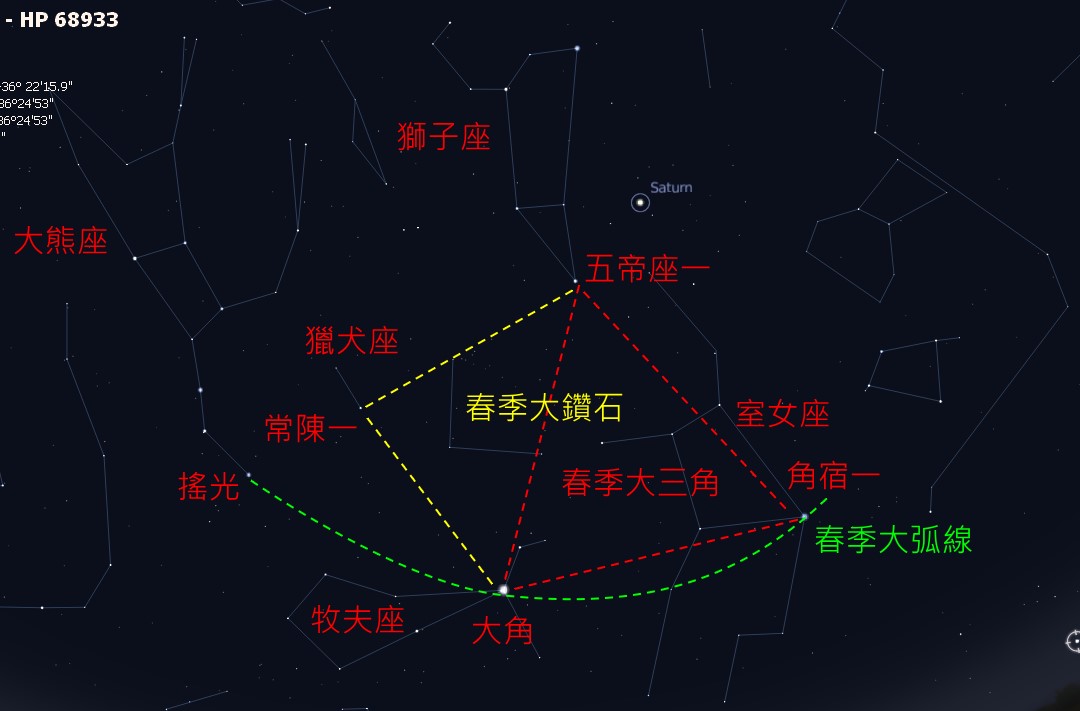
總的來說,春季的星空是由很多不同類型的動物組成,要辨認它們:首先,就要從北斗七星的斗杓:玉衡 、開陽 和搖光 經牧夫座大角 至室女座角宿一 的假想弧線數起,也就是「春季大弧線」。另外,室女座角宿一,獅子座五帝座一 和牧夫座大角 會組成一個等邊三角形,稱為「春季大三角」。「春季大鑽石」(亦被稱為「少女的鑽石」)則由春季大三角再加上獵犬座的常陳一 組成。


看到這個時候,如果發現夜幕已低垂,不仿把頭探出窗外,親身感受一下春季獨特而充滿史詩色彩的星空。也許,你從此會對平常不太留意的夜空有另一番體驗。


夏季星空(Summer Constellation)
看過春季的星座後,就是夏季星座出現之時。有別於其他季的星空,由於地球於夏季時正對著銀河(Milky way)的中心,因此亮星相對地比較多;也就是說,在夏天看到的星空是相對的多樣化。在筆者而言,夏季的夜空是最精彩、璀璨的。

夏季大三角
夏季大三角是夏天的星空標誌,它的出現正告訴別人炎炎夏日已到,是時候享受夏天帶來的火熱魅力!夏季大三角由天鵝座(Cygnus)最亮星---天津四(Deneb)、天琴座(Lyra)最亮星---織女星(Vega)以及天鷹座(Aquila)最亮星---牛郎星(河鼓二Altair)組成。這個大三角周圍有著不少為人熟識的星以及特別的深空天體。


輦道增七---皇帝的座駕 

輦道增七(Albireo)是天鵝座的頭部,是一顆特別的雙星,兩星星等分別為3.1及5.1等*用雙筒望遠鏡或天文望遠鏡可清楚區分兩顆星,一紅一藍,可見兩顆星的表面溫度相差很遠。我們有這樣的常識:藍白色的火焰溫度高,紅色的火焰溫度低。天上的星星也是如此。它們不同的顏色代表表面溫度不同。


衣架星團 


衣架星團是位於織女和牛郎星之間的一個星群,其形狀極似一個衣架,因而得名。星群內大概有40顆星星,同樣可透過雙筒望遠鏡或天文望遠鏡欣賞。


M57---天上的求婚戒指


M57又名戒指星雲(Ring Nebula),屬行星狀星雲(Planetary Nebulae),是低質量恆星死後,核心萎縮爆炸而形成,如有極先進的天文望遠鏡加上極佳的眼力,中心可見到一枚亮度只有15等白矮星(White Dwarf)。

*星等是量度恆星亮度的單位,數字愈大,星則愈暗;數字愈小,星則愈明。


天蠍座(Scropius)

天蠍座是夏季的星空之王,亦是黃道星座之一;最亮星是心宿二(Antares),約0.9-1.2視星等。天蠍看起來像英文字母中的 J 字,頭部由四顆星組成;心宿二是蝎子的心臟,是一顆超紅巨星(Super Red Giant)。天蠍座的心宿二是兩三千年前夏至的標準,又名大火,詩經裡有一句「七月流火,九月授衣」,意思是說,七月份大火已接近地平線,再過兩個月秋天就到,要準備衣服了。希臘神話裡,獵人奧瑞恩(Orion)過於自大,誇口:[我乃天下無敵],引起天神不滿,天后希拉於是派出得意大將殺手大毒蠍刺殺奧瑞恩,於是只要天蠍一出現,獵戶就會躲起來,這兩個冬夏大星座永無在天空相見之日。


天秤座 (Libra)


天秤座是黃道星座之一,代表正義女神所持的天秤。它位於室女的腳下,在室女及天蠍之間。天秤座曾被當成天蠍座的雙螯,因此最亮的兩顆星別名是 北螯 – 氐宿四(Zubeneschamali)和 南螯 – 氐宿一(Zubenelgenubi)


人馬座(Sagittarius)

人馬座是黃道帶星座,在天蝎座旁邊 ,又稱‘射手座’。

最亮星是箕宿三(Kaus Australis),視星等1.8。位於人馬座弓箭位置的八顆星很像一個茶壺:它的壺柄由斗宿一至六組成;而壺嘴則由箕宿一至四組成。壺嘴正好在銀河中心的位置,好像茶壺噴出的煙。至於斗宿一至六,外形很像北斗,被稱為「南斗六星」,有著「南斗注生,北斗注死」的說法。射手是希臘神話中一匹允文允武的人馬(Sagitarius),他是許多英雄的老師父,海格拉斯、雙子卡托斯(Castor)和普勒克斯(Pollux)都是他的門生。然而,他卻死於海格拉斯不小心射出的毒箭之下,宙斯將他移到天上,追射天上的毒物---天蠍,張弓斜對著天蠍的心。

M20,三葉星雲:在壺蓋的位置。包含發射星雲,反射星雲和黑暗星雲,當中的黑暗星雲因遮掩了背後的光,而形成三條裂痕(又名三裂星雲),將發射星雲分隔成為三瓣。


M8,碓湖星雲:也是在三葉星雲附近,是肉眼可見的發射星雲。


海豚座(Delphinus)

海豚座是筆者認為最神似的其中一個星座:四顆星組成一個四邊形的是海豚的頭部,後一直線是海豚的尾。它位於飛馬座與天鷹座之間。最亮星叫瓠瓜四(Sualocin),雖然只有3.6 視星等,但五顆星組合起來就不得不承認它的形狀真的像一條從星海中躍出的海豚。


半人馬座 (Centaurus)和南十字 (Crux)

半人馬座 一個雖有亮星但卻不易被找到的大星座。最亮星是南門二(Rigil Kent),-0.3視星等,是全天第三亮星;而第二亮星則是馬腹一(Hadar),0.6視星等,全天第十一亮星。半人馬座中,還有NGC5139(Omega Centauri)---奧米加星團,也值得觀看,它是全天最大和最光的球狀星團(globular cluster)。南門二則是一顆聚星,用小型望遠鏡都可見到的壯麗雙星:黃色---0等及金黃色---1.4等的兩顆星,週期為80年。此雙星外還有一顆 11等紅矮星(red dwarf star),稱為比鄰星,是最接近太陽的恆星,約4.2光年。
南十字座
最的亮星叫十字架二(Acrux),0.8視星等。由四顆星組成,全都只有視星等2以下,分別是十字架一至四(按順時針數) 。

南天極找法 先是把十字架四、二延伸;南門二、馬腹一連線,再畫垂直平分線,而交遇點便是南天極。有別於北天極,南天極沒有一顆像北極星的亮星給我們作辨認,因此就要靠我們想像出來。

Reference
1. http://www.seds.org/messier/xtra/ngc/brocchi.html
2. http://en.wikipedia.org/wiki/Messier_57

2013年6月15日

[活動預告]暑期天文班 2013 Astronomy Summer Class 2013


夏天將至,未知大家有什麼暑期大計呢?:D

打暑期工?去外國交流?待在家中?

這個暑假,香港大學學生會天文學會特別為你準備了一項極之難忘的活動 — 暑期天文班 2013!!各位可以從中了解到更多的天文知識、與來自不同學校的學生一齊欣賞星空^^ 還有更多更多…


活動日期:7月27日 (香港大學)

7月30日 (香港大學)
8月2-4日 (香港大學嘉道理研究所石崗中心)
(活動為期五日)

對象:全港中三至中六學生
名額:100位 (以隨機抽籤形式抽出)
費用: $455
截止報名日期: 6月21日(五)

報名表格可於下地方索取/下載:
- 暑期天文班2013網頁:http://www.hku.hk/suastro/asc
- 各中學之天文或科學學會

活動特色:
-暑期天文班舉辦至今已經接著半世紀,每年同學反應都非常熱烈。
-同學將以小組形式學習天文知識,寓學習於遊戲,活學活用。
-大學生和中學生打成一片,打破隔膜,更能親身體驗港大文化。
-講座講者為著名天文界資深人士。
-同學更會獲贈本會送出的T恤,其他精美紀念品;並獲發證書一張,以茲證明。
-所有參加者更可得到由MAGAZINES INTERNATIONAL (ASIA) LTD贊助,一年免費贈閱TIME MAGAZINE。

活動內容:
-天文講座
-參觀香港大學物理系天文台
-工作坊
-香港大學校園定向
-觀星
-集體遊戲
-營火舞會
-水戰
天文講座講者:
香港天文台高級科學主任 莫慶炎先生
香港大學理學院科學導師 張師良先生’
香港科幻會會長 李偉才博士

詳情請參閱本活動網址:http://www.hku.hk/suastro/asc
如有查詢,請致電6908 0031 (Phoebe Chiu) / 9344 6918( Lok) 或電郵至 suastro@hku.hk

機會難逢,萬勿錯過!快啲叫埋三五知己一齊報名啦!:D

2013年5月21日

彗星

在今年二至三月, 各位天文愛好者或許聽過那時候有一顆名叫泛星的彗星(C/2011 L4 Pan-STARRS)並對它很感興趣吧!究竟那看上去金黃色的小球是一顆甚麼東西呢?究竟它是怎樣形成?它會為地球帶來甚麼呢?現在讓我為你把問題逐一解答吧!


圖片來源:Daniel Yim Wing Chun (AC49 Steward)


以上的圖片就是泛星彗星, 它在3月5日最接近地面, 在地球1.1天文單位外掠過(1天文單位=地球與太陽的平均距離) 可惜香港觀測條件並不理想,彗星在日落後距地平線不足10度,加上天氣不太好,所以較難觀測。

那有「尾巴」東西是甚麼呢?


圖片來源: http://aeea.nmns.edu.tw


彗星是由冰塊、塵埃及氣體組成。從結構上來說它大致上由彗核、彗髮及彗尾組成。我們可稱彗髮和被包著的彗核為彗頭。有些彗尾很長而且相當光亮,是彗星最顯眼的部分。

如果我們把彗星放大來看,便可清楚看見彗星美麗的結構(看下圖):


這些美麗的彗星是怎麼組成的呢?


圖片來源: Wikipedia

它們本身的直徑的範圍從數百米到數十公里不等。當彗星接近太陽時,太陽的熱力會蒸發彗核內的冰塊,形成煙霧狀的氣體包圍著彗核而形成彗髮。彗尾通常包括直長的「離子尾」(gas tail)和彎曲的「塵埃尾」(dust tail)。

離子尾:長而直,它是由電漿物質構成,易受太陽風的影響。太陽光照射離子尾時,受到很強的散射。紅光有小角度的散射,大部份散射是透過離子尾。而藍光受到大角度的散射,與陽光原進行方向反向,所以離子尾的顏色是淺藍色的。這與晴空為何是藍色的理由完全相同。彗星的彗尾永遠背向太陽,彗尾的形狀隨時都有變化。

塵埃尾:瀰散而彎曲, 是由塵埃物質構成,物質顆粒較大,受太陽風的影響較小。這些塵埃顆粒反射陽光形成了塵埃尾, 塵埃尾中的塵粒會受到太陽重力場的影響而略偏向太陽,這正是塵埃尾並非恰在彗星與太陽的反側,而略彎向太陽的原因。彗尾的長度可以相差很大,有些彗尾很短。

現在我們知道那 「尾巴」和發光點怎樣形成, 但最初的時候彗星是在甚麼地方形成的呢?彗星的形成大體上有兩種看法。

第一個說法就要從太陽系的形成談起了。太陽系的前身,是氣體與塵埃所組成的一大團雲氣,其半徑約15萬個天文單位 , 在46億年前,這團雲氣或許受到超新星爆炸震波的壓縮,開始緩慢旋轉與陷縮成盤狀,圓盤的中心是年輕的太陽。


圖片來源: Nature of the universe

盤面的雲氣顆粒相互碰撞,有相當比率的物質凝結成為行星與它們的衛星,另有部份殘存的雲氣物質凝結成彗星。太陽系形成後的四十多億年中,靠近太陽系中心區域的彗星,或與太陽、行星和衛星相撞,或受太陽輻射的蒸發已消失,我們現在所見的彗星應來自太陽系的邊緣。

所以現在廣為天文學家所接受的理論認為,太陽系大家族包括八大行星與外圍的奧爾特雲與柯伊伯帶。首先解釋何謂彗星週期。彗星週期是彗星沿著自己的軌道繞太陽公轉一圈的時間。一般將彗星分成長週期彗星(long-periodic comet)與短週期彗星(short-periodic comet)。週期少於200年者為短週期彗星,此類彗星的軌道大多與太陽系同一平面。而長週期彗星的軌道與太陽系面的夾角,可為任意角度。長週期彗星可能來至奧爾特雲而短週期彗星可能來自柯伊伯帶。

奧爾特雲理論:在1950年,荷蘭的天文學家Jan Oort提出在距離太陽30,000 天文單位到一光年之間的球殼狀地帶,有數以萬億計的彗星存在,這些彗星是太陽系形成時的殘留物。有些彗星偶爾受到"路過" 的星體的影響,或彼此間的碰撞,離開了原來的軌道。大多數的離軌彗星,從未進入用大型望遠鏡可偵測的距離。只有少數彗星,以各式各樣的軌道進入內太陽系。 不過到目前為止,奧爾特雲理論僅是假設,尚無直接的觀測證據。 柯伊伯帶: 奧爾特雲理論可以合理的解釋,長週期彗星的來源和這些彗星與黃道面(太陽在天球上的軌道平面)夾角的隨意性。但短週期彗星的軌道在太陽系行星的軌道面上,奧爾特雲理論無法合理解答短週期彗星的起源。 1951年,美國天文學家Gerard Kuiper提議在距離太陽30到100天文單位之間有一柯伊伯帶 (或稱為凱伯帶) ,帶上有許多繞行太陽的冰體,這些冰體的軌道面與行星相似,偶爾有些柯伊伯帶物體受到外行星的重力擾動與牽引,而向太陽的方向運行,在越過海王星的軌道時,更進一步受海王星重力的影響,而進入內太陽系成為短週期彗星。


彗星還會為我們帶來甚麼天文現象?

由彗星蒸發出來的彗星物質,顆粒較大者散佈在彗星的軌道上,並循彗星繞太陽的軌道繼續運行。當地球越過這些彗星的軌道時,彗星粒子(流星體)受大氣層影響,進入地球大氣層焚毀發出光芒,構成流星雨的現象。(見下圖)


圖片來源: Journal of Earth Science


流星雨


錯過了2013年年頭的泛星彗星嗎? 不要緊,今年大約十一月將可觀測一顆光度可媲美月亮,將是人類史上有觀測紀錄以來,最亮的「光科網」彗星(C/2012 S1 ISON) 。屆時可以與我們天文學會一起追星,一起親眼見證它在天空閃耀的時刻。


Written by Kernel Ng

2013年4月21日

Dark Matter - Fate of Our Universe

Author: Angus 

Is dark matter really a matter in dark? I will say no but nearly.

Matter that doesn’t emit (or emits very little) nor absorb electromagnetic radiation (or absorbs very little) can be considered as dark matter. The term of dark matter is brought up into the world of astronomy by scientists Jan Oort and Fritz Zwicky in early the 20th century to account for the missing part of the total mass in the universe.

Mass-to-light ratio
is used to express the relation between mass and light output of the mass using (of sun) as reference. So mass-to-light ratio of sun is 1. Scientists found out the light emitted from a galaxy multiplying with the average mass-to-light ratio, the mass of the galaxy comes out , followed by division by the volume that the galaxy occupied, we can find out the average density for luminous matter . If we compare the result to the critical density (the density that makes the universe flat, which mentioned in the last part), the density of luminous matter is only 0.5% of critical density. (Iain Nicolson (2007) “Dark Side of the Universe Dark Matter, Dark Energy, and the Fate if the Cosmos” page34)


1. How we discover 


►The figure shows the relationship between angular velocity of stars orbiting the center of the spiral galaxy and the distance of stars away from the center of the spiral galaxy. Line A is the expected Keplerian result which the stars follow Kepler’s laws (square of orbital speed of star is proportional to cube of distance from the semi-major axis, distance between center and the star). Line B is the actual result observed by advanced telescopes. (Picture from Wikipedia) 


►The picture shows how stars distributed in a spiral galaxy


By Newton’s law of universal gravitation 
 and centripetal force , we get the equation . Assuming the disk part is a perfect circle, and the density of matter is even distributed in the disk, we get mass  for disk part. The larger r (distance between center and star) the smaller w (angular speed) we get, but the reality isn’t. What makes the two lines different? The secret lies under dark matter. 

To remain the angular velocity being the same value when distance increases, extra mass must be added, so a large portion of mass without shining also should be taken into account, those are dark matter.

Also, phenomena of gravitational lens can help scientists to find out dark matter. With the assistance of general relativity, mass distorts the nearby spacetime and bends the light when light travels across. The image of background source may be magnified and distorted because of lensing effect. So if unreasonably distorted of images of stars with no shining massive matter stays in front of it may illustrate the presence of dark matter. 


►The image show the lensing effect (Picture from Wikipedia)


2. Types of dark matter

There are two types of dark matter, one is baryonic dark matter and the second is non-baryonic dark matter.

2.1 Baryonic dark matter

Baryonic matter is a matter that made up by three quarks or antiquarks (not to mention any anti-matter in this article), involving into four fundamental force (strong nuclear force, weak nuclear force, electromagnetic force and gravitational force), simply to say, baryon is everything we see, we touch, we lived with.

Baryonic dark matter is talking about the massive astrophysical compact halo object (MACHO), which is present around our galaxy. It can be black holes, neutron stars and dwarfs (white, brown and red one). Black hole with escape speed equaling to speed of light attracts everything nearby, even light (See more detail in previous article by Wayne Chan). But that doesn’t mean black hole wouldn’t emit electromagnetic wave near event horizon. The wave emitted called Hawking Radiation with interesting characteristic, faster emission rate with smaller black hole. Neutron star is a super dense remnant from massive star during a supernova after throwing off most of its surface layer. The materials in the star are supported by the neutron degeneracy pressure (no two neutron can occupy same quantum state). The mass limit is between 1.4 and around 3.2 (the upper limit of neutron star is still not very sure nowadays) solar mass.

White dwarf is the dense remnant of star after the life of main sequence star ends. The material is supported by electron degeneracy pressure, which is similar to the neutron star’s one, with a 1.4 solar mass upper limit according to Chandrasekhar limit. White dwarfs emit its remaining thermal energy stored and no nuclear fusion takes place, with time flies, the white dwarfs will turn into black dwarf after emitting all its remaining light.

Red dwarf is a main sequence star but with upper limit around 0.35 solar mass, it has much less luminosity and the mass isn’t large enough for helium flash. It only fueled by p-p chain, the nuclear fusion with four protons into helium nucleus.

Brown dwarf with an upper limit around 75 Jupiter mass can’t fuse hydrogen into helium, is considered as fail star.

2.2 Non-baryonic dark matter

Non-baryonic matter is a matter not formed from atoms and quarks. The matter only involve in weak nuclear force and gravitation, which is completely different from baryonic matter. But that “ghost” like particle how can we distinguish between the baryonic dark matter and non-baryonic dark matter?

In the first few moments of our early universe, everything is fixed, including the baryon-photon ratio. During the time, the Big Bang nucleo-synthesis took place, of which only atoms like hydrogen, deuterium (heavy hydrogen), helium-3 (light helium), helium and lithium exist. The portion of different types of atoms depends on the baryon-photon ratio, so too many baryon (>8% of total density) on the early universe causes more helium (larger portion in baryon) that we observed today, and too less baryon (<2% of total density) causes much less helium (lower portion in baryon). In the present moment, the baryon mostly composed of 74% of hydrogen and 26% of helium by mass. Then we can conclude that the baryon abundance lie between 2% and 8% of total density required turning our universe into flat (although our universe isn’t flat but nearly) (Adams Laughlin (1999) “The Five Ages Of The Universe” chapter1). So the other ingredients to fill up the universe are around 23% of dark matter and around 70% for dark energy, only 4.6% from atoms.

Non-baryonic dark matter is divided into three types, Hot Dark Matter (speed comparable with speed of light, neutrino is an example), Warm Dark Matter and Cold Dark Matter, in term of their mass and velocity, of which massive matter means lower speed, so mass and velocity are the same things.

3. Fate of our universe

As the previous paragraph mentioned the term “critical density”, but, how critical density relates to our future?

Our universe is under a battle between the gravitation and the force to expand (dark energy). If the mean density of total matter and radiation exactly equal to the critical density, the universe will expand forever but tends to zero when time travels and Euclidean geometry apply (for example, the triangle is 180 degree). If the mean density is below the critical density, the universe is open and the expansion is kept forever but the rate slows down because of gravity. The curvature of the universe would be negative with saddle-shaped surface (triangle is less than 180 degree). If the mean density is above the critical density, the universe is said to be positive curved with spherical surface (triangle is large than 180 degree), of which the universe is limited space but without boundary. The expansion of the universe will be stopped in someday and start shrinking into a “Big Crunch”.


▲Picture from The University of Hong Kong Department of Physics

The situation mentioned above is all about the possible situation without dark energy. Taking account of dark energy makes the situation more complex.

So, scientists certainly find that the mean density of our universe is lie between 0.1 and 10 where 1 equals to critical density. With the Hubble’s law, the redshift (speed of receding) of other galaxies is proportional to the distance between our Earth and galaxies, which shows the universe is expanding.


But no one knows whether the matter is laid in or out of threshold of critical mass and how our universe will evolve into, maybe only time can tell.

To find more about the topic, related stuff or astronomy magazines, please get more detail in our counter and use Astronomy Library service. WE ARE WAITING FOR YOUR ENQUIRY!!!!!!